Document Templates
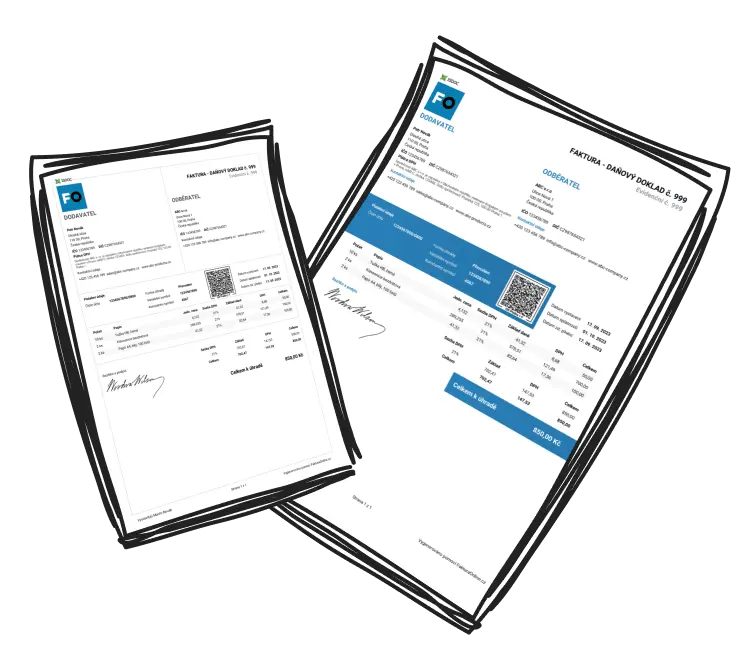

Template of the Invoice
An invoice is a commercial document issued by a seller to a buyer that itemizes the goods or services provided, their quantities, agreed prices and the total amount due. It is the formal request for payment – once sent, the buyer is expected to pay within the stated terms. A well-prepared invoice protects your cash flow, provides a clear audit trail for the IRS and serves as the backbone of your business record keeping.
Template of the Tax Invoice
A tax invoice is a detailed invoice that itemizes the taxes charged on a transaction – showing the taxable amount, the tax rate and the tax amount as separate line items. In the US, a tax invoice is used whenever your business collects state or local sales tax from a buyer. It gives the buyer a transparent breakdown of what they are paying for the goods or services versus what they are paying in tax, and it provides both parties with the documentation needed for accurate tax reporting, deductions and audit compliance.
Template of the Advance Invoice
An advance invoice is issued before goods or services are delivered, requesting either partial or full payment upfront. It is not a final invoice – its purpose is to secure funds before the work begins. The advance invoice should be detailed and transparent, outlining what the client is paying for, the amount, delivery expectations and payment terms. Once the work is completed, you issue a final invoice covering the full supply and offsetting the advance payment already received.
Template of the Pro forma invoice
A pro forma invoice is a preliminary document sent to a buyer before goods are shipped or services are delivered. It outlines the expected items, quantities, prices and terms of a planned transaction – giving the buyer a detailed preview of what the final invoice will look like. A pro forma invoice is not a demand for payment and is not recorded as revenue. It is widely used in international trade for customs declarations, in domestic business to secure prepayment and as a formal price commitment before a sale is finalized.
Template of the Credit Note
A credit note (also known as a credit memo) is a formal document issued by a seller to notify the buyer of a reduction in the amount owed on a previous invoice. It serves as a correction tool for completed transactions – commonly used to account for returned goods, correct pricing mistakes or grant post-invoice discounts. The credit note adjusts the buyer's account balance, which can then be applied to a future purchase or refunded.
Template of the Quote
A quote (also called a quotation or price quote) is a formal document issued by a seller to a prospective buyer, stating the exact price for specific goods or services under defined conditions. Unlike an estimate, which is an approximation, a quote is a fixed-price offer – once the buyer accepts it, both parties are bound by the stated terms and pricing.
Template of the Receipt
A receipt is a document issued by a seller to confirm that payment has been received for goods or services. Unlike an invoice, which requests payment, a receipt proves that the transaction has been settled. It protects both parties – the buyer has documented proof of purchase for tax deductions, expense reports, returns and warranty claims, and the seller has a record that the payment was collected. Receipts are essential in every type of business, from retail and e-commerce to professional services and B2B transactions.
Template of the Sales Receipt
A sales receipt is a proof-of-payment document issued at the time of sale, confirming that goods or services were sold and paid for on the spot. Unlike a standard receipt, which often confirms payment against a previously issued invoice, a sales receipt serves as both the record of the sale and the proof of payment in a single document – no separate invoice is needed. It is the standard transaction record in retail, food service, personal services and any business where the customer pays immediately.
Template of the Purchase Order
A purchase order (PO) is a formal document issued by a buyer to a supplier, confirming the intention to purchase specific goods or services under agreed terms. It specifies exactly what is being ordered, in what quantities, at what price and where it should be delivered. Once the supplier accepts the PO, it becomes a legally binding agreement between both parties.
Template of the Estimate
An estimate is a preliminary document that outlines the expected costs for a job, service or product delivery before work begins. It sets clear expectations between your business and the client – covering scope, pricing and timeline – and serves as a starting point for negotiation. An estimate is not an
Template of the Delivery Note
A delivery note (also called a packing slip or dispatch note) is a document that accompanies a shipment of goods, listing exactly what has been delivered. Unlike an invoice, it does not request payment – it serves as confirmation that the buyer received the correct items in the correct quantity and condition. A signed delivery note is one of the strongest forms of proof of delivery in any commercial dispute.
Template of the Credit Memo
A credit memo (also called a credit note) is a document issued by a seller to a buyer to reduce the amount owed on a previous invoice. It is commonly used to correct billing errors, acknowledge returned goods, apply retroactive discounts or resolve service disputes. A credit memo is not a refund in itself – it adjusts the buyer's account balance, which can then be applied to a future purchase or settled as a refund.
Template of the Cash Receipt
A cash receipt is a document that confirms payment has been received for goods or services. Unlike an invoice, which requests payment, a receipt is issued after the money has been collected – serving as proof of the transaction for both the seller and the buyer. Receipts are essential for transparency, accurate financial record-keeping and tax compliance.