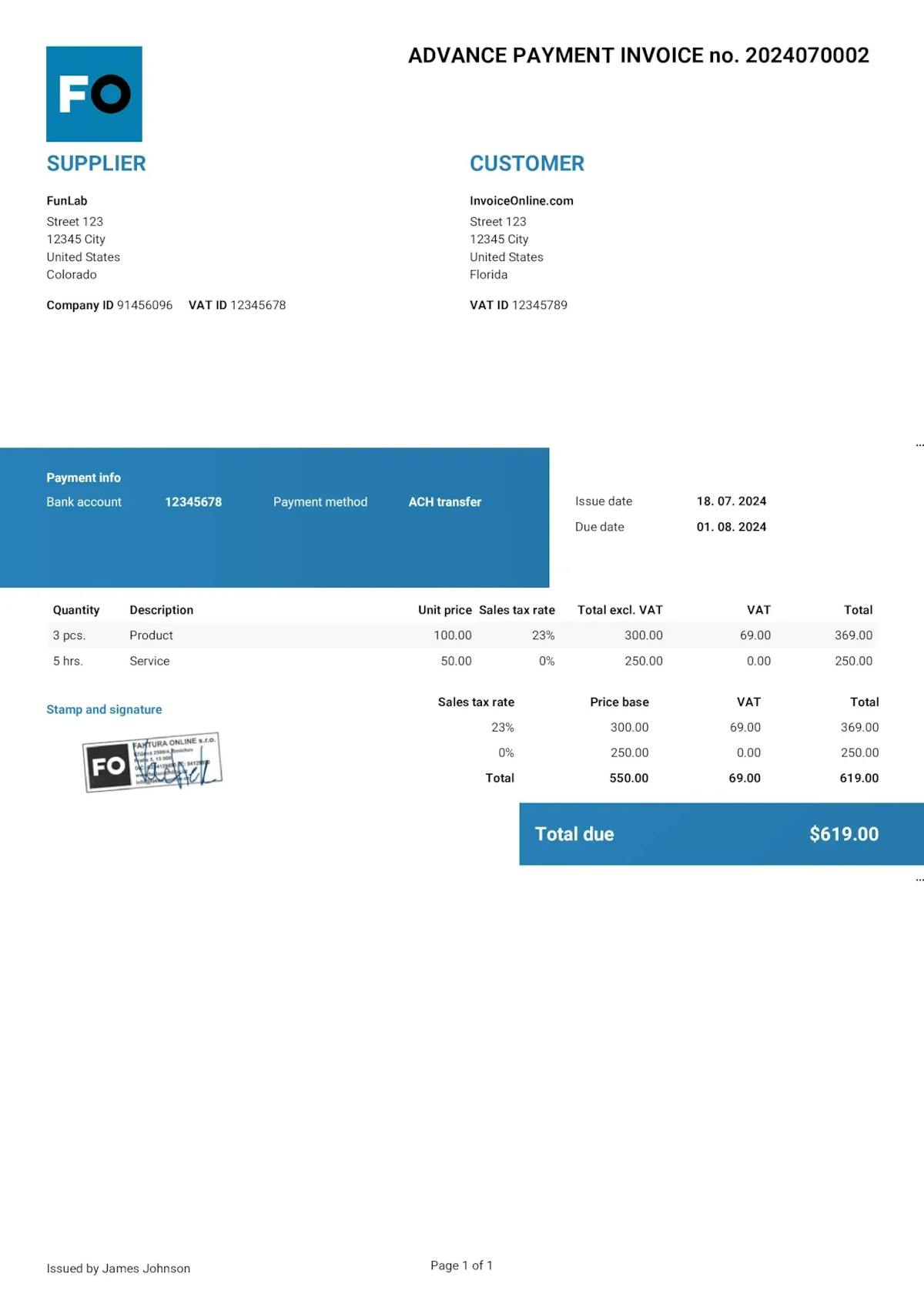
Template of the Advance Invoice
An advance invoice is issued before goods or services are delivered, requesting either partial or full payment upfront. It is not a final invoice – its purpose is to secure funds before the work begins. The advance invoice should be detailed and transparent, outlining what the client is paying for, the amount, delivery expectations and payment terms. Once the work is completed, you issue a final invoice covering the full supply and offsetting the advance payment already received.
What should an advance invoice include?
There is no federally mandated format for an advance invoice in the US – it is a commercial document, not a tax return. However, to ensure the client knows exactly what they're paying for and to protect both parties, it should include the following:
Essential information
Document label – "Advance Invoice" or "Deposit Invoice" (never just "Invoice" – this avoids confusion with the final invoice).
Invoice number – a unique identifier for tracking and matching to the final invoice.
Issue date – the date the advance invoice was created.
Payment due date – the deadline for the deposit.
Seller details – business name (or personal name for sole proprietors), address, EIN (Employer Identification Number) or SSN if sole proprietor, and state tax ID if registered for sales tax.
Buyer details – business name or personal name, billing address, EIN (for B2B transactions).
Description of goods or services – a clear explanation of what the advance covers (e.g. "Initial deposit for 50 custom chairs, including labor and materials").
Advance amount – the partial or full payment being requested.
Payment details – accepted payment methods (check, ACH, wire transfer, credit card), bank details or payment link.
Recommended additional information
Quantity and unit price – a breakdown showing how the advance amount was calculated (e.g. hourly rate, number of units).
Sales tax – if your state requires sales tax to be collected at the time of deposit, show the tax amount separately. If tax is due only upon delivery, note that clearly.
Total contract value – if the deposit covers only part of the order, include the full estimated price so the client can see the remaining balance.
Payment terms – specify whether the payment is partial or full, any late fees, and the refund policy.
Delivery timeline – expected start date and completion date.

An advance invoice is not a final invoice. Do not use it as the sole record of the transaction. Once the work is completed and delivered, issue a proper final invoice that references the advance payment and shows the remaining balance (if any). This keeps your books clean and gives the client a complete paper trail.

Sales tax on deposits – it depends on your state. Some states (e.g. Texas, California) require you to collect sales tax when the deposit is received, even before delivery. Others only require tax at the time the goods are delivered or the service is completed. Check your state's Department of Revenue guidelines – getting this wrong can lead to penalties.
When and why is an advance invoice used?
Advance invoicing is the practice of requesting payment before delivery of a product or service. It secures upfront funds, which is especially useful for custom orders, large projects or situations where the seller incurs significant preparation expenses.
Custom or bespoke work – For high-value projects (construction, software development, custom manufacturing), a deposit covers your material and labor costs before the work is finished.
New clients with no payment history – When you haven't worked with a client before, a deposit minimizes the risk of delivering and not getting paid.
Stage-based projects – For long-running projects, you can request a deposit before each milestone. Each advance invoice then corresponds to one phase of the work.
Cash flow protection – An advance payment ensures you have funds to cover upfront costs before the project is complete and the final invoice is issued.
Formalizing the commitment – A paid deposit reduces cancellations and no-shows, and signals that both parties are serious about moving forward.

Industries that commonly use advance invoicing:
Event planning – venue booking, catering, equipment rental.
Construction and contracting – materials, permits, subcontractor deposits.
Custom manufacturing – bespoke furniture, signage, specialized parts.
Freelancers and consultants – project-based work, retainers.
Legal and professional services – retainer fees before work begins.

Advance invoice vs. proforma invoice: Both documents request payment before delivery and neither is a final invoice. The practical difference is that an advance invoice typically requests a partial payment (deposit), followed by a final invoice after delivery. A proforma invoice usually requests the full amount upfront and is commonly used in international trade or as a formal price confirmation.
Invoice like a pro.
Your clients will see that your invoice matches your brand.
Add your logo or stamp in just seconds. Editable templates make it easy to customize everything to fit your business.

Your logo on every invoice
Upload your own logo and make every invoice look professional and unmistakably yours.

10 types of documents
Choose what you want to issue – invoice, receipt, quote, estimate and others.

Add your signature
Need a company stamp or signature on your invoice? Just upload it – it'll show up automatically.