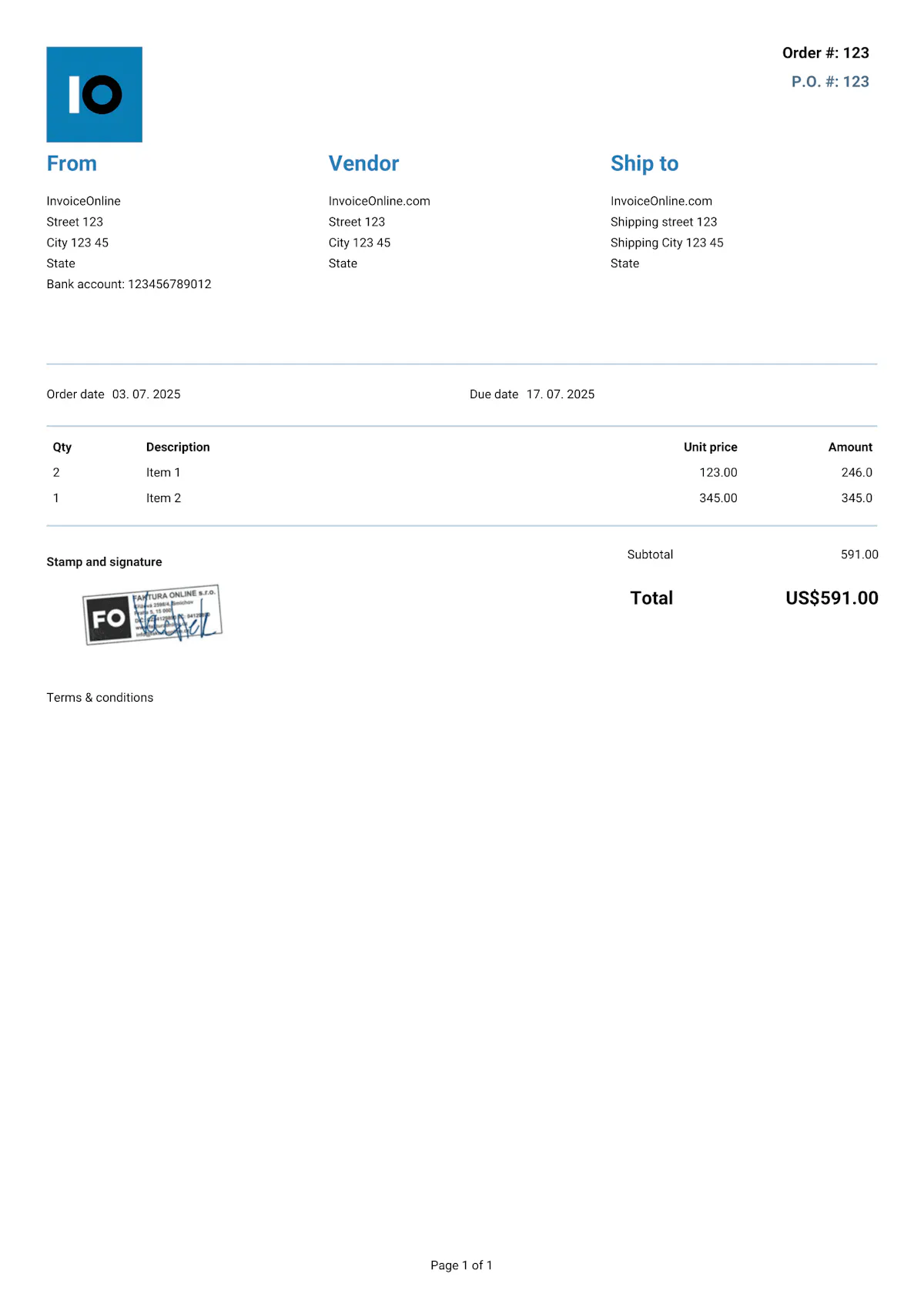
Template of the Purchase Order
A purchase order (PO) is a document issued by a buyer to formally request goods or services from a supplier under agreed terms. Once the supplier confirms the order, it becomes binding on both parties – and forms the basis for the invoice, delivery note and any subsequent dispute. Although UK law does not prescribe a specific format, a well-prepared purchase order prevents misunderstandings and protects both you and your trading partner.

What should a purchase order include?
For a purchase order to serve its purpose – providing legal and commercial certainty for both sides – it should contain the following details:
Essential information
Document label – "Purchase Order" or "PO".
PO number – a unique sequential identifier.
Date of issue – the date the order was raised.
Buyer details – business name, company number, VAT number (if registered), address and contact person.
Supplier details – business name, company number, VAT number (if registered), address and contact person.
Description of goods or services – individual line items with quantities and unit prices.
Total price – net amount, VAT (if applicable) and gross total.
Recommended additional information
Delivery terms – required delivery date, delivery address and shipping method.
Payment terms – e.g. "Net 30 days from invoice date" or "50 % deposit on order, balance on delivery".
Reference to a quote or contract – if the PO follows on from an estimate or framework agreement.
Authorisation – signature of the person authorised to commit the purchase, or electronic approval.
Terms and conditions – cancellation policy, returns, warranty, liability.

Tip
The PO number should always be communicated to the supplier and quoted on the corresponding delivery note and invoice. This enables straightforward three-way matching – PO, delivery note, invoice – and significantly simplifies accounting on both sides.
When and why is a purchase order used?
A purchase order is not just a formality – it is a practical tool that protects both parties and brings structure to commercial relationships:
Legal certainty – An accepted PO creates a binding commitment. If the supplier fails to deliver what was ordered, or the buyer refuses to pay, the PO serves as evidence of the agreed terms.
Cost control and budgeting – POs give you a clear record of committed spend. Finance teams can track outstanding orders against budgets before the invoices even arrive.
Efficient document matching – The PO number links the order to the delivery note and invoice, creating a clean audit trail. Many accounting systems automate this three-way match.
Professionalism – Issuing a formal PO signals that your business operates systematically. Suppliers take PO-backed orders more seriously and prioritise them accordingly.
Dispute resolution – If there is a disagreement about what was ordered, when, or at what price, the PO is the first document both parties refer to.

Even as a sole trader or small business, purchase orders are worth using – especially for larger orders or new suppliers. They don't have to be complicated: a simple document identifying both parties, specifying what you're ordering and at what price is enough to protect you if something goes wrong.