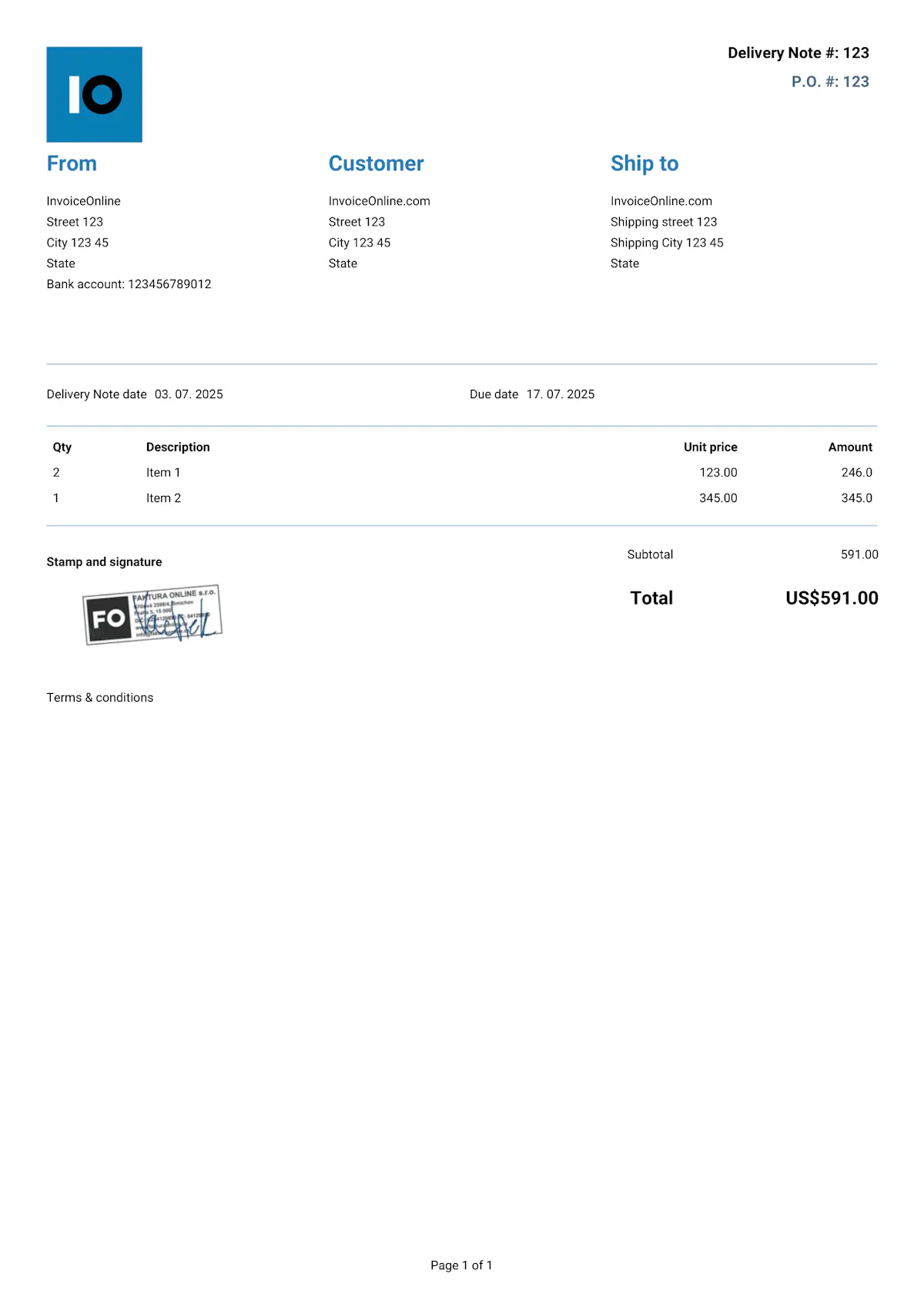
Template of the Delivery Note
A delivery note (also called a packing slip or dispatch note) is a document that accompanies a shipment of goods, listing exactly what has been delivered. Unlike an invoice, it does not request payment – it serves as confirmation that the buyer received the correct items in the correct quantity and condition. A signed delivery note is one of the strongest forms of proof of delivery in any commercial dispute.

What should a delivery note include?
There is no federal requirement for delivery notes in the US, but a well-prepared one protects both parties and streamlines receiving, inventory and accounting.
Essential information
Document label – "Delivery Note", "Packing Slip" or "Dispatch Note".
Delivery note number – a unique sequential reference for tracking and matching to the invoice and purchase order.
Date of dispatch – the date the goods were shipped.
Seller / shipper details – business name, address and contact person.
Buyer details (Bill to) – business name or personal name and billing address.
Ship to address – the delivery destination, if different from the billing address.
Description of goods – a detailed list of each item in the shipment, including product names or SKUs.
Quantity – the number of units of each item delivered.
Signature section – space for the recipient to sign, confirming they have received the goods.
Recommended additional information
Purchase order (P.O.) number – reference to the original order for three-way matching (PO → delivery note → invoice).
Unit price and total value – optional, but helpful for the buyer's receiving team to cross-check against the order.
Carrier and tracking number – the shipping company and tracking reference (e.g. UPS, FedEx, USPS tracking ID).
Weight and package count – total weight and number of packages in the shipment.
Condition notes – space for the recipient to note any damage, shortages or discrepancies at the time of delivery.

Unlike an invoice, a delivery note does not include a payment request. Its sole purpose is to confirm what was shipped and received. Pricing is optional – many businesses deliberately omit prices from delivery notes so warehouse staff focus on checking quantities rather than values.
When and why is a delivery note used?
A delivery note is used whenever goods are shipped from seller to buyer – whether as part of a sale, a return, or an internal transfer. It serves multiple practical purposes:
Proof of delivery – A delivery note signed by the recipient is strong evidence that the goods arrived. This is critical if a dispute arises about whether the order was fulfilled.
Receiving checklist – The buyer's warehouse or receiving team uses the delivery note to check each item against the shipment, confirming that the order matches what was sent.
Returns and claims – If goods are damaged, missing or incorrect, the delivery note (with condition notes) provides the documentation needed to file a claim or request a credit note.
Inventory and stock control – Delivery notes help both parties keep accurate stock records. The seller knows what left the warehouse; the buyer knows what arrived.
Partial and split deliveries – When a large order is shipped in multiple batches, each delivery note documents exactly which items were included in that particular shipment.

Always include a signature line – an unsigned delivery note has far less evidential value. Have the recipient sign and print their name, along with the date of receipt.
Add a condition notes section – if the recipient notices damage or shortages at the point of delivery, they should note it on the delivery note immediately. This makes any subsequent claim much easier to process.
Link every delivery note to a P.O. – referencing the purchase order number on the delivery note enables clean three-way matching: PO → delivery note → invoice.
Keep copies for at least 3 years – delivery notes are part of your business records. The IRS may require them as supporting documentation if delivery timing or quantities are ever questioned.

Delivery note vs. bill of lading: A delivery note confirms what has been shipped directly between seller and buyer. A bill of lading (BOL) is a more formal transport document issued by the carrier – it serves as a contract of carriage, a receipt for the goods, and in some cases a document of title. For domestic shipments between businesses, a delivery note is usually sufficient. For freight, LTL (less-than-truckload) or international shipments, a bill of lading is typically required in addition to the delivery note.
Invoice like a pro.
Your clients will see that your invoice matches your brand.
Add your logo or stamp in just seconds. Editable templates make it easy to customize everything to fit your business.

Your logo on every invoice
Upload your own logo and make every invoice look professional and unmistakably yours.

10 types of documents
Choose what you want to issue – invoice, receipt, quote, estimate and others.

Add your signature
Need a company stamp or signature on your invoice? Just upload it – it'll show up automatically.