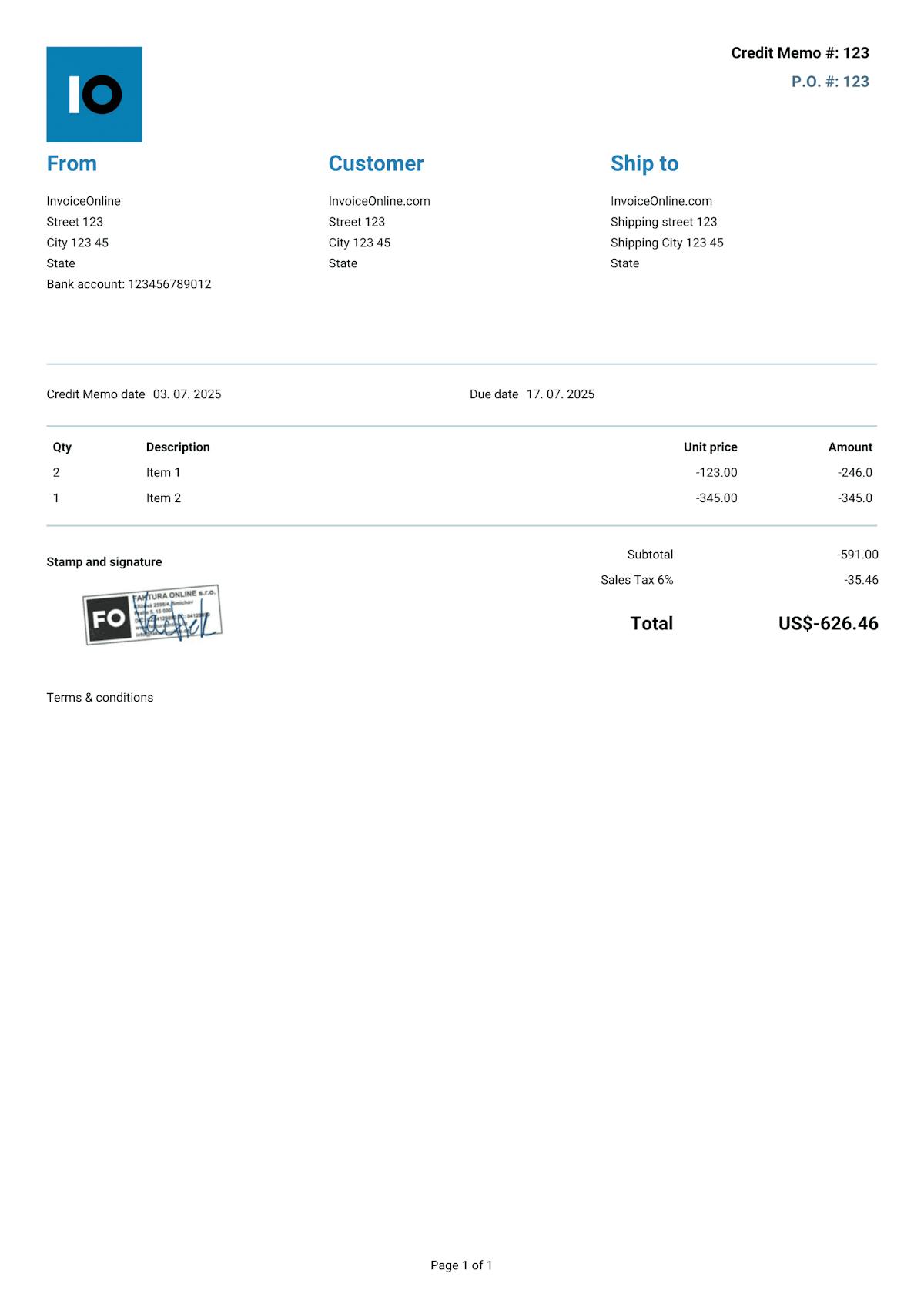
Template of the Credit Memo
A credit memo (also called a credit note) is a document issued by a seller to a buyer to reduce the amount owed on a previous invoice. It is commonly used to correct billing errors, acknowledge returned goods, apply retroactive discounts or resolve service disputes. A credit memo is not a refund in itself – it adjusts the buyer's account balance, which can then be applied to a future purchase or settled as a refund.

What should a credit memo include?
There is no federally mandated format for a credit memo, but it should contain enough detail for both parties – and their accountants – to trace the adjustment back to the original transaction.
Essential information
Document label – "Credit Memo" or "Credit Note".
Credit memo number – a unique sequential identifier for tracking.
Date of issue – the date the credit memo is created.
Original invoice reference – the invoice number (and date) being corrected. This is critical for matching the adjustment to the right transaction.
Seller details – business name, address, EIN (Employer Identification Number) and state tax ID if registered for sales tax.
Buyer details (Bill to) – business name or personal name, billing address.
Reason for the credit – a clear explanation of why the adjustment is being made (e.g. "Returned 10 units of Item #A-205" or "Pricing correction per contract terms").
Description of items or services credited – what is being adjusted, with line-item detail.
Credit amount – the total amount being credited, shown as a negative or clearly labeled reduction.
Recommended additional information
Ship to address – if different from the billing address (especially relevant for goods returns).
Purchase order (P.O.) number – reference to the original purchase order for three-way matching.
Quantity and unit price – for partial credits, show exactly how many units are being credited and at what price.
Sales tax adjustment – if the original invoice included sales tax, the credit memo should reduce the tax proportionally.
Settlement method – how the credit will be applied (refund to original payment method, credit against next invoice, or account credit).

A credit memo can only be issued by the seller. The buyer cannot create a credit memo on their own – if they believe an adjustment is warranted, they must request one from the seller. This is an important distinction for accounts payable and receivable teams.

Sales tax on credit memos: If the original invoice included state or local sales tax, the credit memo should adjust the tax accordingly. In most states, you can claim a sales tax deduction on your return for the period in which the credit memo was issued. Keep the credit memo and the original invoice together as documentation – your state's Department of Revenue may require both during an audit.
When and why is a credit memo used?
Credit memos are issued after an invoice has been sent to correct or adjust the amount owed by the buyer. Typical scenarios include:
Product returns – The buyer returns part or all of a shipment. The credit memo reduces the outstanding balance by the value of the returned goods.
Billing errors – The original invoice included incorrect pricing, wrong quantities or a duplicate charge. A credit memo corrects the record without voiding the entire invoice.
Service disputes – The client received incomplete or unsatisfactory services. A credit memo acknowledges the shortfall and adjusts the amount owed.
Retroactive discounts – A loyalty rebate, volume discount or promotional pricing that was agreed after the original invoice was issued.
Overpayments – The customer accidentally paid more than the invoiced amount. A credit memo records the surplus, which can be applied to a future invoice or refunded.
Order cancellation – The customer cancels an order that has already been invoiced but not yet delivered. The credit memo reverses the full invoice amount.

Credit memo vs. refund: A credit memo reduces the buyer's account balance – it does not necessarily mean money is returned. The credit can be applied to a future purchase, offset against another outstanding invoice, or settled as a cash refund. The settlement method should be stated on the credit memo so both parties are clear on how the adjustment will be handled.

Always reference the original invoice – a credit memo without an invoice reference is difficult to reconcile and may cause confusion during audits.
Issue promptly – the sooner you issue a credit memo after the issue arises, the easier it is to reconcile both sets of books.
Use sequential numbering – maintain a separate number series for credit memos (e.g. CM-001, CM-002) so they are easy to distinguish from regular invoices.
Keep records for at least 3 years – the IRS requires supporting documentation for all items on your tax return. Credit memos are part of that documentation.
Invoice like a pro.
Your clients will see that your invoice matches your brand.
Add your logo or stamp in just seconds. Editable templates make it easy to customize everything to fit your business.

Your logo on every invoice
Upload your own logo and make every invoice look professional and unmistakably yours.

10 types of documents
Choose what you want to issue – invoice, receipt, quote, estimate and others.

Add your signature
Need a company stamp or signature on your invoice? Just upload it – it'll show up automatically.