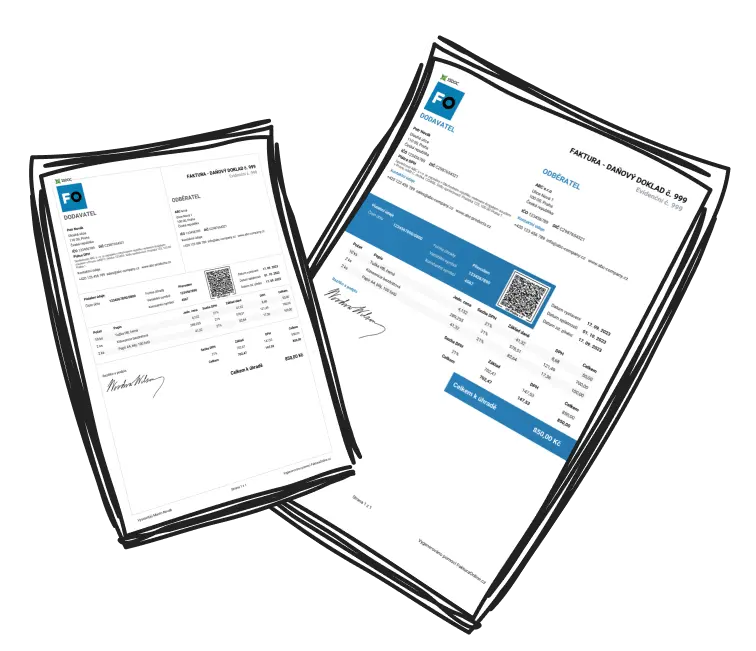
Paper vs. Electronic Invoices: Pros, Cons and the Law

Paper and electronic invoices are equally valid
US federal law doesn’t prescribe what form an invoice must take. There is no federal VAT and no federal rule on invoice format. The closest equivalent is sales tax, and each state sets its own: see our guide to sales tax in the USA.
An electronic invoice can be:
a PDF sent by email,
a structured e-invoice, a data file your customer’s accounting software reads on its own.

PDF or e-invoice?
Both are electronic records under the law. Someone has to read a PDF and retype the numbers, while a structured e-invoice goes straight into the accounting system.
What US law says
ESIGN Act. Under this federal law, a signature, contract or other record cannot be denied legal effect solely because it is electronic.
UETA. The Uniform Electronic Transactions Act, adopted by most states, applies the same principle under state law.
No duty to go electronic. Neither law forces a business to use or accept electronic records. Between businesses, you simply agree on the format. ESIGN’s special consent rules protect consumers.
IRS. In most cases, the IRS doesn’t require records to be kept in any special manner. Rules for paper records apply equally to electronic ones: they must be complete, accurate and accessible.
You can scan paper invoices and destroy the originals if your system reproduces them accurately and legibly, lets you retrieve them and has been tested to do so.
How long to keep invoices
The same periods apply to paper and electronic invoices. Keep records that support your tax return until the period of limitations runs out:
3 years after filing in most cases,
6 years if you leave out income of more than 25% of the gross income on your return,
7 years if you claim a bad debt deduction or a loss from worthless securities,
4 years for employment tax records, from when the tax is due or paid, whichever is later,
indefinitely if you don’t file a return or file a fraudulent one.
Your state may set its own rules for sales tax records.
Paper invoices: pros and cons
Pros
No equipment or setup needed.
Works for customers who don’t handle electronic documents.
Cons
Printing and postage cost money.
Delivery takes days, and so does payment.
Paper can get lost or damaged.
Archives take up physical space for years.
Electronic invoices: pros and cons
Pros
Delivered in seconds, so customers can pay sooner.
No printing or postage.
Easy to search and back up.
Structured e-invoices remove retyping errors.
Cons
Files must stay readable for the whole retention period.
Without a backup, one failed drive can wipe out your records.
Email is a common channel for fake invoices that imitate real suppliers. Learn how to tell if an invoice is fake.
Is e-invoicing mandatory?
No. Federal and state law don’t require businesses to invoice each other electronically. Some large customers and government buyers ask suppliers to use their portals, but that is a contract condition, not a general legal rule. More in our guide to e-invoicing in the US.

Switching to electronic invoices
Agree with each customer on the format and the email address for invoices.
Store each invoice with the order and proof of payment.
Back up in at least two places.
Verify any unexpected invoice from a “known” supplier before you pay.
Which format to choose
Electronic suits most small businesses and freelancers: faster, cheaper and easier to store.
Paper makes sense for customers who refuse email invoices.
A mix works too: scan the paper invoices you receive and keep one digital archive.
FAQ:
Is a PDF invoice sent by email legally valid in the US?
Yes. Under the ESIGN Act and state UETA laws, a record cannot be denied legal effect just because it is electronic.
Do I need my customer’s consent to send electronic invoices?
Between businesses, there is no formal consent rule. Just agree on the format. Special consent rules apply to consumers.
How long do I have to keep electronic invoices?
As long as paper ones: generally 3 years after you file the return, longer in specific cases.
Is e-invoicing mandatory for US businesses?
No. Electronic invoicing between businesses is voluntary under federal and state law.