Small Business Tax Deductions: What You Can Write Off
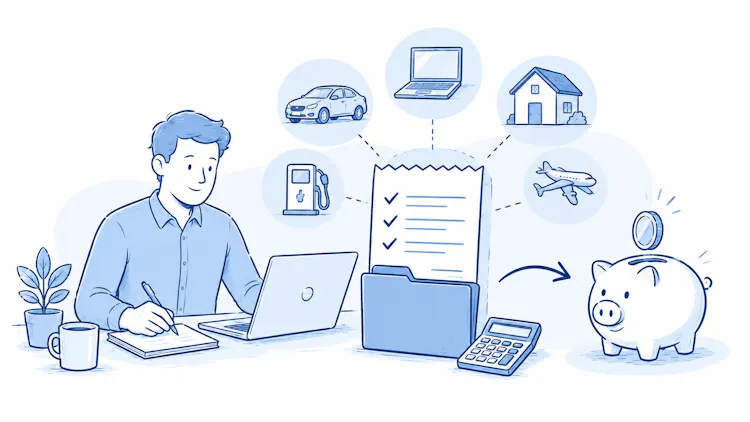
What makes an expense deductible
The IRS uses a simple test. An expense is deductible when it is both ordinary and necessary for your business.
Ordinary means it is common in your line of work.
Necessary means it is helpful and appropriate. It does not have to be essential.
A graphic designer buying design software passes the test easily. The same designer buying a family TV does not.
Three rules follow from this:
Personal costs stay personal. Groceries, vacations and your daily commute are never business expenses.
Mixed use means splitting the cost. If something serves both your business and your private life, you deduct only the business share.
Large purchases are spread out. Equipment and vehicles are usually deducted over several years, a process called depreciation. Special rules let you deduct them faster.

Splitting a mixed-use expense
Your phone plan costs $80 a month.
You use the phone 60% for business.
Deductible amount: $80 × 12 × 60% = $576 a year.
Everyday business expenses
Most small business owners deduct the same core costs. Sole proprietors and single-member LLCs report them on Schedule C, the form for business income and expenses.
Rent and utilities for an office, studio or workshop
Software and subscriptions, such as accounting, invoicing, design and cloud tools
Advertising and marketing, including your website and paid ads
Professional fees for accountants, lawyers and tax preparers
Business insurance
Wages and contractor payments
Office supplies and small equipment
Bank fees, payment processing fees and interest on business loans
Courses and training that improve skills for your current business
Business travel: flights, hotels and local transport away from home
Car, meals and home office
These three deductions are the most popular. They also come with the most rules.
Car expenses
You can choose between two methods:
Standard mileage rate. You multiply your business miles by a rate the IRS sets each year. It covers fuel, repairs, insurance and depreciation.
Actual expenses. You add up your real car costs and deduct the business percentage.
The standard rate is simpler. If you own the car and want to use the standard rate, you must choose it in the first year you use the car for business. Driving from home to your regular workplace counts as commuting and is not deductible.
Business meals
You can usually deduct half the cost of a meal with a client, customer or business partner. The same applies to meals while you travel for business.
Entertainment is not deductible. Concert tickets, golf and sports events don't count, even with a client.
Home office
You can deduct part of your housing costs if you use a space regularly and exclusively for business. A spare room used only as an office qualifies. A dining table does not.
You can pick between two methods:
Simplified method: you deduct a fixed amount per square foot, up to a set limit. No receipts for utilities are needed.
Regular method: you deduct the real share of rent or mortgage interest, utilities, insurance and repairs. This method gives a larger deduction for bigger spaces, but you need full records.
Renters qualify too. Employees working from home do not.
Equipment and large purchases
Normally, a computer, machine or vehicle is deducted over its useful life. Two options let you deduct the full cost right away:
Section 179. You choose which items to deduct in full in the first year. There is an annual limit, and the deduction cannot be larger than your business income.
Bonus depreciation. Qualifying equipment can be deducted at 100% in the first year. There is no dollar limit, and the deduction can create a loss.
What counts is the date you start using the item, not the date you buy it. A laptop bought in late December but unpacked in January belongs to the next tax year.

Current figures (2026)
Business mileage: 72.5¢ per mile (Jan–Jun), 76¢ (Jul–Dec)
Simplified home office: $5 per sq ft, max. 300 sq ft ($1,500)
Section 179 limit: $2,560,000
SEP IRA / solo 401(k) total limit: $72,000
Startup costs: up to $5,000 in the first year
Deductions for self-employed owners
Some deductions don't go on Schedule C. They reduce your income directly on your personal tax return, Form 1040:
Half of your self-employment tax. Self-employment tax pays for Social Security and Medicare. How it works is covered in our guide to self-employment tax rates and how to pay them.
Health insurance. You can deduct premiums for yourself and your family if you can't get an employer-subsidized plan.
Retirement savings. Contributions to a SEP IRA or solo 401(k), retirement plans designed for small business owners, lower your taxable income.
Qualified business income (QBI) deduction. Owners of sole proprietorships, partnerships, LLCs and S corporations can deduct up to 20% of their business profit. Some service businesses with high incomes get a reduced deduction.
Starting a business
Costs you pay before opening, such as market research, pre-launch advertising and training, are startup costs. You can deduct a limited amount in your first year. The rest is spread over 15 years.
If you form an LLC or corporation, the legal and filing fees are organizational costs. They follow the same rule with a separate limit.
What you cannot write off

The IRS never accepts
commuting between home and your regular workplace,
personal and family expenses,
entertainment, such as tickets, golf or club memberships,
fines and penalties paid to a government,
political contributions,
clothing you could also wear outside of work.
Records that hold up
If the IRS questions a deduction, you have to prove it. Good records answer four questions: how much, when, where and why.
Keep:
receipts and invoices for expenses,
bank and card statements,
a dated mileage log,
a short note on the business purpose of meals and trips,
the invoices you issued, which prove your income.
Once your expenses are sorted by category, entering them on Schedule C and Form 1040 is a simple step.

Make tax time easier
Use a separate bank account and card for the business.
Photograph receipts the day you get them.
Review your expenses monthly, not once a year.
FAQ:
What is the difference between a tax deduction and a tax credit?
A deduction lowers the income you pay tax on. A credit lowers the tax itself, dollar for dollar. That makes a $1,000 credit worth more than a $1,000 deduction.
Can I deduct expenses if my business made a loss?
Yes. A sole proprietor's business loss can usually offset other income, such as wages from a job. If you report losses year after year, the IRS may ask whether the activity is a real business or a hobby.
Can I deduct my home office if I rent?
Yes. Renters follow the same rules as homeowners. The space must be used regularly and only for business.
Should I use the standard mileage rate or actual car expenses?
The standard rate is easier and works well if you drive a lot in an affordable car. Actual expenses can give a bigger deduction for an expensive car or one you use almost only for business. Either way, you need a mileage log.
Do I need receipts for small purchases?
You need proof of the amount, date, place and business purpose. A bank statement shows that you paid, but not why. Keep the receipt or add a short note.
Can I deduct the cost of starting my business?
Yes, within limits. You can deduct part of your startup costs in the first year your business operates. The rest is deducted gradually over 15 years.