Mastering Mathematical Lexicon: Understanding the 'Result of Calculation'
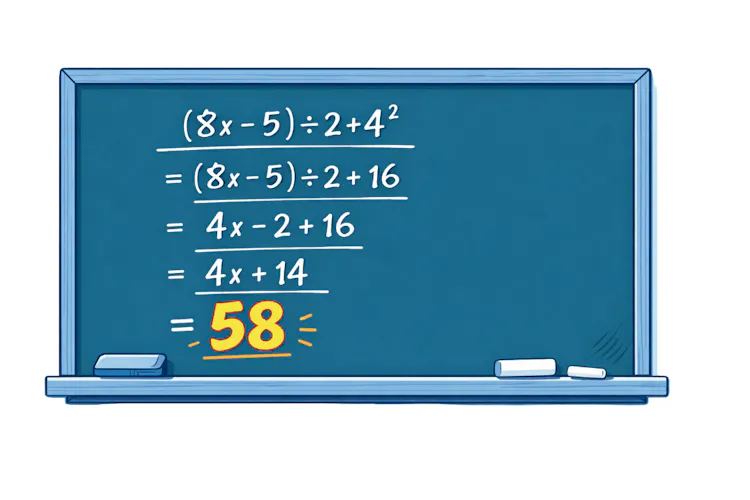
Many people use mathematical terms interchangeably—do you know which of the following terms means a result of calculation? The phrase 'result of calculation' usually refers to concepts like 'answer,' 'output,' or 'solution.' Here's a detailed breakdown of these terms:
Answer: Often used in basic arithmetic to describe the numeric outcome of operations like addition or subtraction.
Output: A broader term commonly used in mathematical functions, referring to the value produced when inputs are processed through a function.
Solution: A formal term referring to the value(s) that solve an equation or satisfy a problem.
Value: Refers to the specific number or symbolic representation resulting from evaluating an equation or function.

Example
For the equation 5 + 3 = 8, the result (8) is the 'answer' to the addition calculation.
Conclusion: While different terms are used depending on the context, "solution" is the primary formal term for the result of a calculation.
What is the term used to describe the result of a calculation?
Uncover the exact label mathematicians use to denote the final outcome of a calculation! The term often used for the result of a calculation is 'solution' or 'answer'. When considering which of the following terms means a result of a calculation, for basic operations like addition or multiplication, 'answer' works, while in algebra, 'solution' stands out.

The outcome of an arithmetic operation is often termed an 'answer,' but for equations, it is called a 'solution.'
Can you identify the word that represents the result of calculation?
What term do you think represents the result of a calculation? Pause to consider terms like "output," "solution," or "result." When considering which of the following terms means a result of calculation, the context is critical; however, 'result' frequently emerges as the most suitable term.
Step-by-Step Explanation:
In basic math, the answer to a calculation like 2 + 2 = 4 is commonly called the 'answer.'
Moving into algebra, solving an equation like x + 3 = 5 yields a 'solution' (x = 2).
Across fields, when generalizing, the answer may simply be called the 'result.'
Which mathematical term defines the outcome of a calculation?
Which of the following terms means a result of estimation in a universal sense? 'Result' or 'output' are broadly accepted to describe the completion of mathematical operations.
Example
For the equation 3 × 4 = 12, the result is 12, also known as the 'product.'
How can we refer to the result of performing a calculation in mathematical terms?
Whether you're solving for "x" or adding numbers, there’s always one term that fits! Mathematicians use terms like "result," "solution," or "output," varying by the type of mathematical operation performed. Ultimately, "result" serves as a unifying term across most mathematical contexts, simplifying the lexicon and promoting clarity.