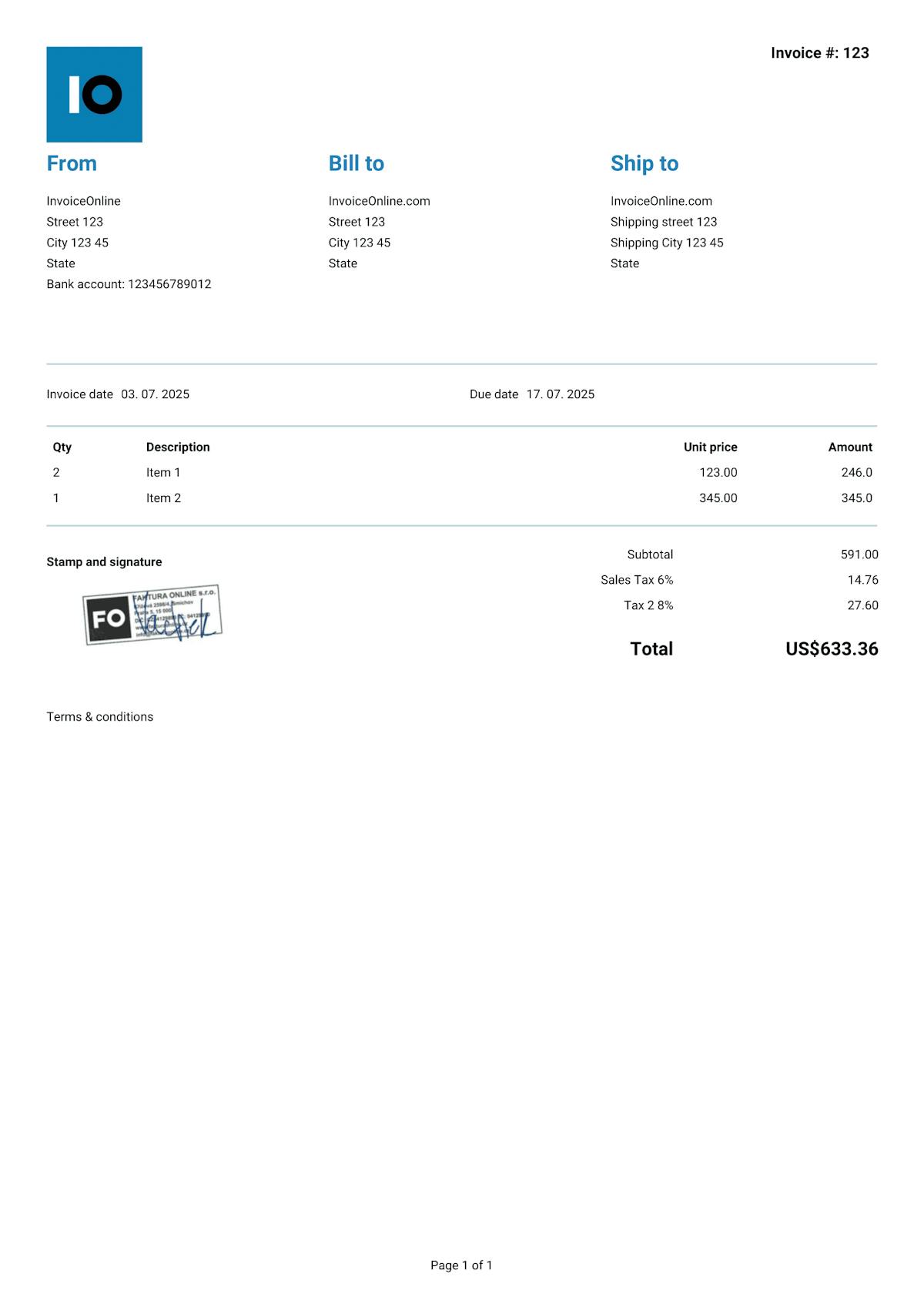
Template of the Tax Invoice
A tax invoice is a detailed invoice that itemizes the taxes charged on a transaction – showing the taxable amount, the tax rate and the tax amount as separate line items. In the US, a tax invoice is used whenever your business collects state or local sales tax from a buyer. It gives the buyer a transparent breakdown of what they are paying for the goods or services versus what they are paying in tax, and it provides both parties with the documentation needed for accurate tax reporting, deductions and audit compliance.

What should a tax invoice include?
The US does not have a federally mandated tax invoice format (unlike VAT countries such as the UK or EU member states). However, most states that collect sales tax require that invoices and receipts clearly show the tax amount separately. A complete tax invoice meets those requirements and provides the documentation the IRS and your state's Department of Revenue expect.
Essential information
Document label – "Tax Invoice" or "Invoice" (clearly marked to distinguish it from estimates, quotes and receipts).
Invoice number – a unique sequential identifier for tracking, reconciliation and auditing.
Date of issue – the date the invoice is created and sent.
Due date – when payment is expected (e.g. Net 15, Net 30, Net 60).
Seller details – business name, address, phone, email, EIN (Employer Identification Number) and state sales tax permit number (also called seller's permit, sales tax ID or certificate of authority, depending on the state).
Buyer details (Bill to) – full name or business name and billing address. If the buyer is tax-exempt, include their exemption certificate number.
Description of goods or services – a detailed, line-by-line breakdown of what was provided.
Quantity and unit price – the number of units and the price per unit for each line item.
Subtotal (before tax) – the sum of all line items before any tax is applied.
Sales tax line(s) – the tax rate and tax amount shown separately. If multiple tax jurisdictions apply (state + county + city + special district), show each on its own line.
Total amount due – subtotal plus all applicable taxes.
Payment instructions – how the buyer should pay: check, ACH, wire transfer, credit card or online payment link.
Recommended additional information
Ship to address – the delivery destination. For sales tax purposes, the ship to address often determines which tax rate applies (destination-based sourcing), not the seller's location.
Purchase order (P.O.) number – if the buyer issued a purchase order, reference it. Many corporate AP departments reject invoices without a matching P.O.
Tax-exempt notation – if the sale is exempt from sales tax (e.g. resale, non-profit, government purchase, interstate sale), state the reason and the buyer's exemption certificate number.
Late payment terms – any interest or fees on overdue balances (e.g. "1.5 % per month on overdue amounts").
Early payment discount – an incentive for fast payment (e.g. "2/10 Net 30"). Note: discounts may affect the taxable amount in some states – apply tax before or after the discount based on your state's rules.
Taxability indicators per line item – mark each line as taxable or non-taxable. Mixed invoices (e.g. taxable products + non-taxable services in the same transaction) are common, and clear labeling prevents errors.

The ship to address matters for sales tax. Most US states use destination-based sourcing – the sales tax rate is determined by where the goods are delivered, not where the seller is located. A handful of states (including California, Texas and others for certain transaction types) use origin-based sourcing. If you ship to multiple states, you must apply the correct rate for each destination. Getting this wrong means either overcharging the customer or underpaying the state – both create problems.
When and why is a tax invoice used?
A tax invoice is used whenever you need to document the tax collected on a sale – for your own records, for the buyer's records and for your state's Department of Revenue. Common scenarios include:
Sales tax collection – Any time you sell taxable goods or services in a state where you have nexus (a taxable presence), you must collect sales tax and document it. The tax invoice is that documentation – it shows the rate applied, the amount collected and the jurisdiction.
Multi-jurisdiction transactions – When a sale involves multiple tax layers (state + county + city + special district), a tax invoice breaks each one out separately. This is essential in states like Colorado, Louisiana or Alabama where local taxes are administered independently from state tax.
B2B transactions and resale – Business buyers need detailed tax invoices for their own records. If the buyer is purchasing for resale and provides a valid resale certificate, the tax invoice should note the exemption and show zero tax. The seller must keep the resale certificate on file.
International trade – When selling to businesses in VAT countries (UK, EU, Canada, Australia), the buyer may require a tax invoice to claim input tax credits under their local VAT rules. A detailed US tax invoice with proper tax breakdowns satisfies most international requirements.
Audit documentation – During a state sales tax audit, the auditor will review your invoices to verify that you collected the correct tax rate, applied exemptions properly and remitted the right amount. A clear, itemized tax invoice is your best defense.

Always show tax as a separate line – never bury sales tax inside the unit price. Most states require it to be shown separately, and buyers expect to see exactly how much tax they are paying.
Keep exemption certificates on file – if a buyer claims a sales tax exemption (resale, non-profit, government), collect and store their exemption certificate before the first tax-free sale. Without it, you may be liable for the uncollected tax during an audit.
Label mixed invoices clearly – if an invoice includes both taxable and non-taxable items (e.g. taxable products + non-taxable professional services), mark each line accordingly. This prevents overtaxing the buyer and protects you during audits.
Retain tax invoices for at least 3–4 years – the IRS requires 3 years of records from filing; most states require 3–4 years for sales tax records. Some states (e.g. California) require 4 years. Keep both the invoice and any supporting exemption certificates together.
Invoice like a pro.
Your clients will see that your invoice matches your brand.
Add your logo or stamp in just seconds. Editable templates make it easy to customize everything to fit your business.

Your logo on every invoice
Upload your own logo and make every invoice look professional and unmistakably yours.

10 types of documents
Choose what you want to issue – invoice, receipt, quote, estimate and others.

Add your signature
Need a company stamp or signature on your invoice? Just upload it – it'll show up automatically.