Work-life balance for freelancers: Myth or achievable goal?
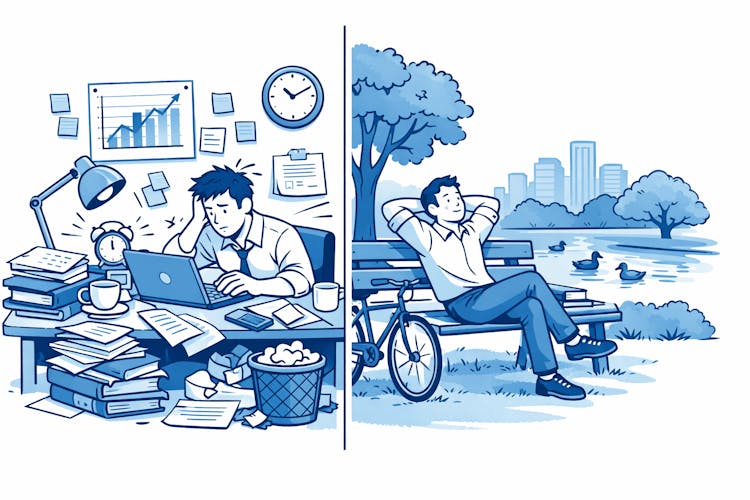
Why traditional work-life balance advice doesn’t apply to freelancers
Work-life balance is usually addressed from the employee’s perspective – set boundaries, leave on time, disconnect. However, as a freelancer, you don't have fixed working hours, a boss to send you home, or a colleague to cover for you.
The difference is significant: An employee balances work and life. A freelancer juggles roles as a salesperson, accountant, marketer, customer support – all while trying to live a life in between.
That's why the simple "disconnect at five" doesn't work. But a system that you consciously set up yourself does.

Work-life balance doesn’t mean working fewer hours. It means having control over when and on what you work – and when you consciously take time off.
4 pillars of balance for entrepreneurs
Imagine balance as a table with four legs. It only takes one being shorter for everything to wobble.
1. Time – your most valuable resource
Most freelancers don’t have a problem with not working enough. The problem is working on the wrong things. Three hours spent on invoices instead of three hours with a client.
What helps:
Time audit – record what you do in 30-minute blocks for a week. The result is often surprising.
3 priorities rule – each day, choose a maximum of 3 tasks to complete. Everything else is a bonus.
Time blocking – allocate specific blocks for specific activities (Monday morning = administration, Tuesday = client meetings).
2. Energy – not every hour is created equal
You accomplish more in one hour at 8 a.m. than at 4 p.m. Yet many entrepreneurs start their day with emails and administration – leaving important work for the afternoon when they lack energy.

Graphic designer Petra moved her creative work to the morning (8–12) and emails, invoices, and administration after lunch. She started completing a third more projects in the same number of hours – and had energy for her family in the evening.
3. Relationships – the silent sacrifice of entrepreneurship
This pillar is talked about the least, but it’s often the first to crumble. “I’ll just finish one more thing” is a phrase too often heard by freelancers' partners and families.
Practical tip: Establish non-negotiable non-work rituals – shared dinners, weekend walks, Wednesday nights without phones. Treat them like meetings with your most important client.
4. Health – the foundation often forgotten first
As the whole company, no one pays you sick leave or sends a replacement. Yet many freelancers postpone exercise, cut sleep, and replace meals with coffee.

Burnout is not a question of weak will. Studies show that over 40% of entrepreneurs experience symptoms of burnout. Prevention is cheaper than treatment – and mainly, it won't take you out of work for weeks.
Setting boundaries with clients – without losing business
The biggest fear for freelancers: “If I’m not available 24/7, the client will leave.” In reality, clients respect professionals who have clear rules.
How to:
Communicate availability in advance. A simple sentence in your email signature or on your website: “I respond to emails within 24 hours on business days.”
Set up a work phone or at least define working hours on your mobile. The client calls stop after six in the evening.
Learn to say “I’ll do it tomorrow” instead of responding immediately. Urgent does not equal important.
Copywriter Tomáš changed his contract from “response within 2 hours” to “response within 24 hours on business days” – and didn’t lose a single client. But he gained peaceful evenings and weekends.
Automation: Let tools handle the routine
A lot of work that costs you time and energy can be automated or significantly simplified. This is where you create the space for the “life” in work-life balance.
Tasks that typically waste time unnecessarily:
Manual invoicing and payment tracking
Re-entering client information
Sending repeated reminders
Monthly income and expense reports
With the tool InvoiceOnline, you can issue an invoice in just a few clicks, automatically monitor due dates, and have a financial overview in one place. The time you save on administration can be spent on work – or finally on yourself.
Review your typical workweek and mark all activities you do repeatedly and in the same way. These are the candidates for automation or delegation.
Simple test: How’s your balance?
Honestly answer these 4 questions:
Time: Do you know how many hours you actually work each week? (Tip: most freelancers guess wrong by 10-15 hours.)
Energy: Do you do your most important work when you have the most energy?
Relationships: Did you have at least one evening this week without work?
Health: Do you regularly sleep 7+ hours and exercise at least 3 times a week?
If you answered “no” to more than two questions – it’s time to change something. Not tomorrow. Today.
Work-life balance is not a state you achieve and then you’re done. It’s ongoing balancing – and that’s okay. What’s important is that you consciously strive for it.
FAQ
Is it realistic to have work-life balance as a self-employed person?
Yes, but it looks different than for employees. It’s not about fixed working hours, but about consciously managing time, energy, and boundaries.
How many hours per week should a self-employed person work?
There is no universal number. The key is quality over quantity—and being aware of how many hours are truly productive versus just “sitting at the computer.”
How do I refuse a client who calls in the evening or on weekends?
Set clear rules from the start of the collaboration. If the habit is already established, adjust gradually—for example, stop responding after 8:00 PM and reply the next morning.
Can a shared office (coworking) help separate work and personal life?
Yes, for many self-employed people, physically separating work and home is essential. It helps create a mental boundary—once you leave, the workday is over.
How can I tell I’m approaching burnout?
Warning signs include chronic fatigue, cynicism toward work, decreased performance, irritability, and insomnia. If you recognize these signs, consider seeking professional support.
Is it possible to maintain work-life balance during peak seasons?
In high-demand periods, perfect balance is unrealistic. What matters is having a recovery plan afterward and maintaining at least the basics during the busy time—sleep and one day off per week.
What apps help with time management for self-employed people?
It depends on your needs—for time tracking, Toggl or Clockify; for task management, Todoist or Trello; and for invoicing, InvoiceOnline—the key is not to try everything at once, but to choose 2–3 tools and stick with them.
Does it make sense to plan a vacation as a self-employed person?
Absolutely. Plan it in advance, inform clients ahead of time, and set up automatic replies. Your business will survive a week without you—and you’ll return with a clearer mind.